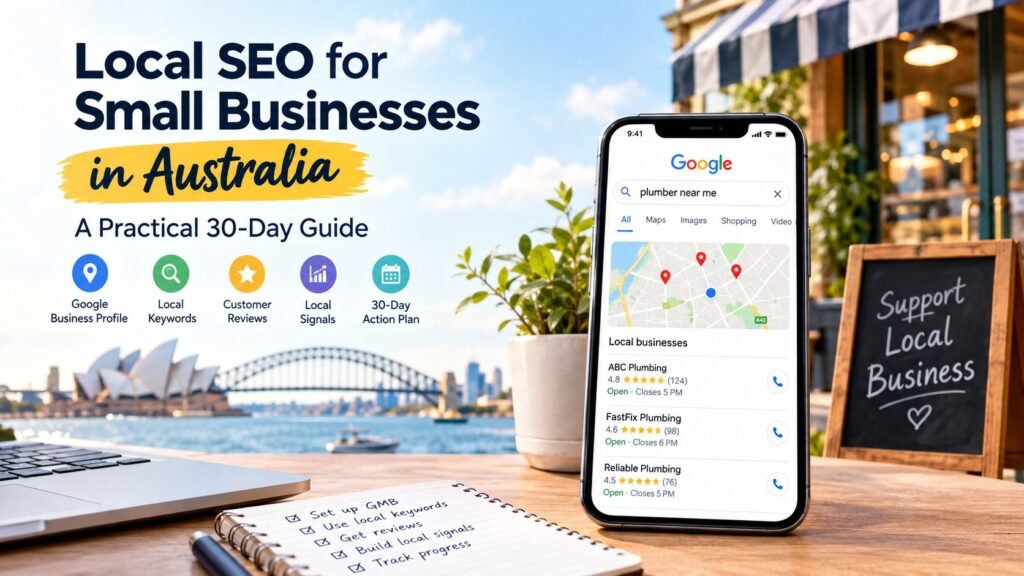

A customer in Parramatta searches “emergency plumber near me.” Google shows three businesses on the map. Yours is not one of them.
That customer may call a competitor instead. This is why local visibility matters for small businesses that depend on customers in a specific area.
The good news is that local SEO for small businesses is one of the few marketing channels where a small team can compete with bigger businesses. You do not need a huge budget. You need the right steps, done consistently. If you are building your wider online presence, our guide to digital marketing for small businesses explains how local SEO fits into a broader digital marketing strategy.
This guide shows you how to improve your local visibility in Australia. You will learn how to set up your Google Business Profile, choose suburb-level keywords, earn reviews, build local signals and track your progress. At the end, you will have a simple 30-day plan to follow.
What Is Local SEO and Why Does It Matter for Small Businesses in Australia?
Local SEO helps your business appear when people search for products or services in your area. It can help you appear in three main places:
- The local pack: The map and business listings that often appear near the top of Google.
- Google Maps: Where people search for nearby businesses and services.
- Regular search results: Local searches such as “accountant Hobart” can also return relevant businesses and websites.
Google has said that local results are influenced by factors including relevance, distance and prominence.
- Relevance is how well your business profile matches what someone searches for.
- Distance refers to how close your business is to the searcher or the location used in the search.
- Prominence reflects how well known and established a business is. Reviews, links and other mentions can contribute to this.
You cannot control distance, but you can improve the relevance and prominence of your business.
This matters because many Australian small businesses serve a defined geographic area. A cafe in Fremantle, an electrician in Bendigo and a physio in Newcastle all depend heavily on nearby customers. For these businesses, ranking for relevant local searches can be more valuable than trying to rank nationally.
There is also an opportunity for businesses that have a website but have not properly set up their local search presence.
Step 1: Set Up Your Google Business Profile Properly
Your Google Business Profile is one of the most important local SEO assets for a small business. It is free and can be one of the first things potential customers see when they search for your business or services.
Claim your profile through Google Business Profile and complete the verification process. Google may ask you to verify your business using the options available for your profile.
If You Have a Shopfront
Complete every relevant field accurately.
- Business name: Use your real trading name. Do not add keywords to your business name simply to rank better.
- Primary category: Choose the most specific category that accurately describes your business. For example, “Italian restaurant” is more specific than “restaurant.”
- Secondary categories: Add only categories that genuinely apply to your business.
- Hours: Keep your opening hours accurate and update them for public holidays or temporary changes.
- Photos: Add genuine photos of your premises, team, products and work. Keep them updated.
- Description: Explain what you do and who you serve using clear, natural language.
For example, a bakery in Fremantle could use “Bakery” as its primary category and add relevant secondary categories such as “Cake shop” or “Coffee shop.” It can also upload genuine photos and keep its opening hours updated.
If You Are a Service-Area Business
Many Australian tradies, cleaners and mobile businesses do not have a shop where customers visit them.
If customers do not visit your business location, you may be able to hide your street address and list the areas you genuinely serve instead.
Follow these basic rules:
- Only list areas where you actually provide services.
- Do not use a fake address or virtual office simply to create a local presence.
- Keep your service areas focused and realistic.
For example, an electrician based in Joondalup who serves nearby northern suburbs could list areas such as Joondalup, Wanneroo, Hillarys and Currambine if those are genuinely within the service area.
Quick Wins Most Businesses Miss
- Add your relevant services and products with useful descriptions.
- Turn on messaging if you can respond promptly.
- Publish occasional updates, offers or business news.
- Answer relevant questions in the Q&A section.
- Set up your business on Bing Places and Apple Business Connect as additional local search platforms.
Step 2: Target Suburb-Level Keywords and Improve Your On-Page SEO
People do not always search for a service using a broad keyword such as “plumber.” They may search for terms such as “plumber Brisbane southside” or “blocked drain Paddington.”
Your website should reflect the way potential customers actually search.
Find the Right Local Keywords
Start with a simple combination of your service and location.
Examples include:
- “dentist Parramatta”
- “wedding photographer Gold Coast”
- “bookkeeper near me”
Then research your ideas:
- Search the keyword on Google and review the suggestions that appear.
- Check “People also ask” and “Related searches.”
- Review the keywords and pages used by competitors that rank well.
- Use tools such as Google Keyword Planner to understand potential search demand.
Choose one main keyword or search intent for each important page. Avoid trying to make one page rank for every service and location.
Optimise Your Website for Local Searches
Google needs clear information about what your business does and where it operates. Start with these on-page basics:
- Title tag: Include the relevant service and location where appropriate. For example, “Emergency Plumber Southside Brisbane | Smith Plumbing.”
- Headings: Use your target keyword naturally in the H1 and relevant subheadings.
- Location pages: Create pages for important service areas when they provide genuinely useful local information. Include local details, relevant services, real examples and genuine customer information where appropriate.
- Contact details: Keep your business name, address and phone number consistent across your website and important business listings.
- ABN: Display your ABN where appropriate, such as in the footer, to provide additional business information.
- Embedded map: Consider adding a Google Map to your contact page when relevant.
- Schema markup: Consider using appropriate LocalBusiness structured data to help search engines understand your business information.
Avoid vague statements such as “serving all of Australia” when your business actually serves a smaller geographic area.
Also avoid creating near-identical location pages where only the suburb name changes. Each location page should offer genuinely useful and locally relevant information.
Make Sure Your Site Works on Mobile
Many local searches happen on mobile devices, so your website needs to provide a good mobile experience.
Test your site on a real phone and check that:
- Pages load quickly.
- Your phone number is easy to tap.
- Text is easy to read without zooming.
- Important information is easy to find.
Step 3: Build Reviews, Citations and Local Links
This step helps strengthen your local presence. It can take longer than setting up your profile and website, but consistent local signals can make a meaningful difference.
Reviews
Reviews can influence how customers perceive your business and are an important part of your online reputation.
To encourage genuine reviews:
- Ask at the right moment: Request a review after completing a job or sale when the customer has had a chance to experience your service.
- Make it easy: Send customers a direct review link by SMS or email.
- Respond to reviews: Thank customers for positive feedback and respond professionally to negative feedback.
- Be consistent: Aim for genuine reviews over time rather than trying to generate a large number all at once.
Never buy reviews, create fake reviews or manipulate customers into leaving misleading feedback. Australian consumer protection rules prohibit misleading conduct, and businesses should follow current guidance when running review campaigns.
Citations and Directories
A citation is an online mention of your business information, such as your business name, address and phone number.
Consistency matters. If your listing uses “Suite 2, 10 George St” in one place and “10 George Street” somewhere else, inconsistent information can make your business details less clear.
Start with relevant Australian directories, such as:
- Yellow Pages Australia
- TrueLocal
- Hotfrog
- Yelp Australia
- Industry-specific directories such as Hipages or ServiceSeeking for relevant trades
Then look for directories that are relevant to your industry or region. A medical clinic, for example, may benefit from relevant healthcare directories, while a wedding venue may benefit from wedding-related platforms.
Check each listing carefully. A smaller number of accurate, relevant listings is better than filling your profile with low-quality or irrelevant directories.
Local Backlinks
Links from relevant local websites can help establish that your business is connected to the community.
Some practical opportunities include:
- Sponsoring a local sports club and asking whether your business can be included on its sponsor page.
- Joining a relevant local chamber of commerce.
- Providing expert comments or useful information to a local news site or blog.
- Building partnerships with complementary local businesses.
- Supporting or participating in local events and promoting them online.
A relevant link from a trusted local organisation can be more valuable than collecting large numbers of unrelated directory links.
Step 4: Your 30-Day Local SEO Action Plan
Reading about local SEO is easy. Consistently implementing it is what matters.
Here is a simple 30-day plan.
Week 1: Foundations
- Claim and verify your Google Business Profile.
- Choose your primary and relevant secondary categories.
- Complete all relevant profile fields.
- Upload genuine business photos.
- Set up Bing Places and Apple Business Connect.
Week 2: Your Website
- Choose a main search target for your homepage and each important service page.
- Update title tags, headings and meta descriptions.
- Add your business name, address, phone number and ABN where appropriate.
- Add relevant LocalBusiness structured data.
- Check your website’s mobile experience and loading speed.
Week 3: Reviews and Listings
- Send review requests to recent customers who have genuinely used your services.
- Respond to existing reviews.
- Add your business to four or five relevant Australian directories.
- Check and correct inconsistent business information.
Week 4: Links and Tracking
- Contact two or three relevant local partners or organisations about potential collaborations or links.
- Publish one useful local blog post or location page.
- Set up Google Analytics and review your Google Business Profile performance data.
- Record your starting numbers for calls, website clicks and direction requests.
How to Track Your Results
You cannot improve what you do not measure.
Keep an eye on:
- Google Business Profile performance: Monitor actions such as calls, website clicks and direction requests where available.
- Google Search Console: See which searches are bringing visitors to your website.
- Local rankings: Check how your business performs for important local searches from relevant locations.
- Leads: Ask new customers how they found your business.
Review your numbers regularly and make small improvements based on what you learn. Local SEO usually works better as an ongoing process than as a one-time project.
Common Mistakes to Avoid
- Adding keywords to your business name when they are not part of your real business name.
- Using a fake address or virtual office to create a local listing.
- Letting your opening hours become outdated.
- Ignoring negative reviews.
- Creating duplicate or near-identical location pages.
- Expecting significant results after only one week.
Frequently Asked Questions
How long does local SEO take to work?
There is no fixed timeline. Some small businesses may see early changes within one to three months, while stronger results can take three to six months or longer. The timeline depends on your industry, location, competition and the strength of your existing online presence.
A business in a less competitive regional market may see progress sooner than a business competing in a highly competitive area such as inner Sydney.
How much does local SEO cost in Australia?
Doing local SEO yourself mainly requires time and consistent effort. If you hire an agency, costs can range from a few hundred dollars per month to several thousand depending on the services and scope of work.
Treat pricing estimates as a starting point rather than a fixed market rate. When comparing agencies, ask what is included and how results will be reported.
Should I do local SEO myself or hire an expert?
If you have a few hours each week, you can manage many of the basic tasks yourself. This guide covers the main foundations.
Consider professional help if you operate multiple locations, work in a highly competitive market or do not have enough time to manage your local presence. Ask agencies for relevant examples of their work and a clear explanation of what they will do.
Is local SEO still worth it with AI search?
Yes. Search behaviour is changing as Google and AI-powered search tools continue to develop, but accurate and trustworthy business information remains important.
A complete business profile, consistent listings, genuine reviews and useful website content can help establish trust across traditional and emerging search experiences. However, no one can guarantee specific rankings or visibility in AI search.
Does local SEO work for B2B businesses?
Yes. An IT support company, accounting firm or commercial cleaning company can still benefit from local SEO if it serves customers in a defined geographic area.
The same foundations apply: accurate business information, relevant local content, reviews where appropriate and strong local signals.
Conclusion: Start Small, Stay Consistent
Local SEO for small businesses does not need to be complicated. It is about being clear, accurate and visible where your customers are searching.
Here is what to remember:
- Set up your Google Business Profile completely and accurately.
- Use suburb-level keywords on pages that provide genuine value.
- Earn genuine reviews and keep your business information consistent.
- Build relevant local relationships and links.
- Follow the 30-day plan, then review your results regularly.
Your next step is simple. Open your Google Business Profile today and check every important field. If anything is incomplete or inaccurate, fix it before moving on to the next task.
Small improvements, done consistently, can build a stronger local search presence over time.